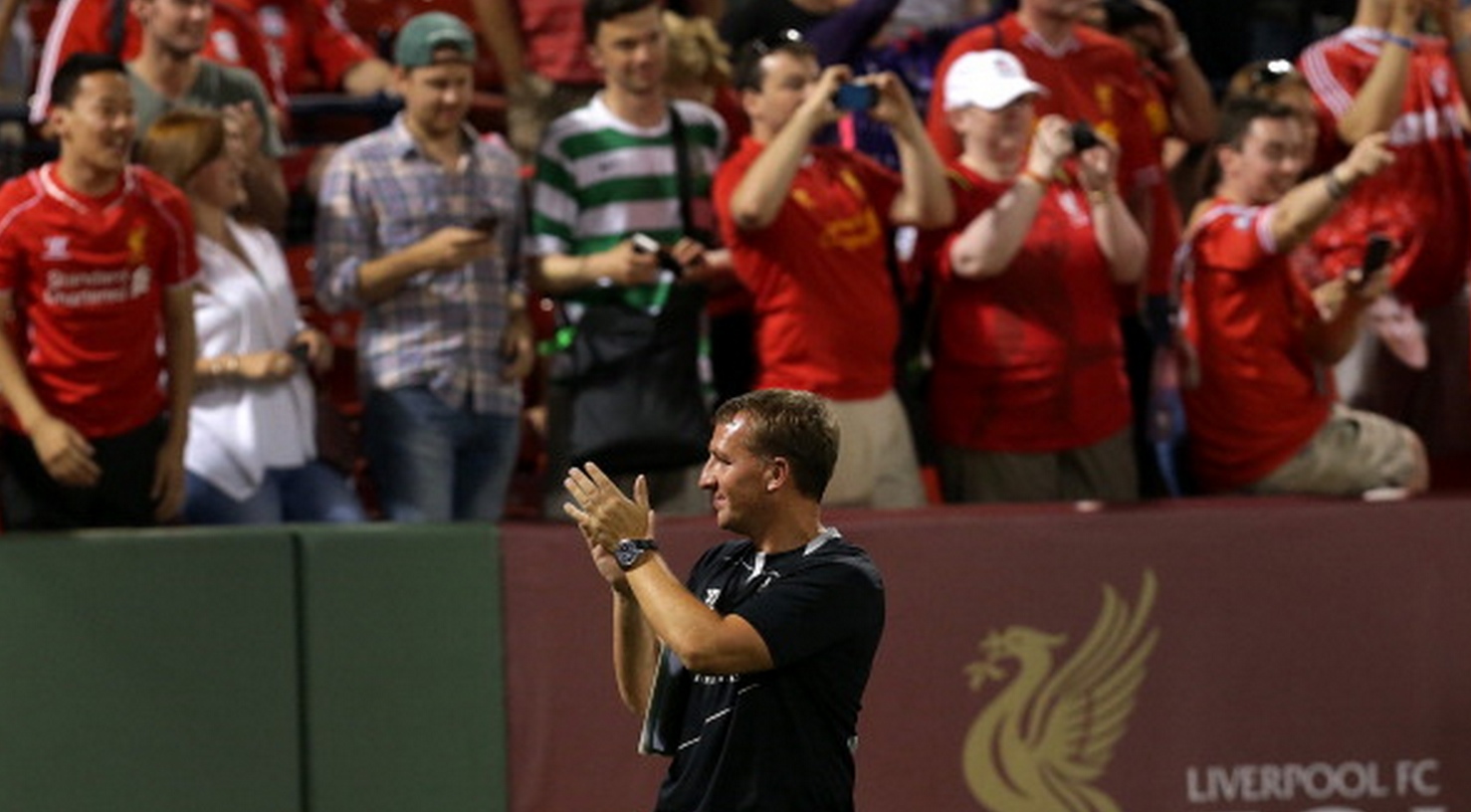

Having watched Liverpool look rather flat at times during three friendly games this month, the same old cliché terms are being banded about as players, staff and fans alike endure the almost teasing nature of pre-season. “It’s all about getting fit” and “giving new signings time to settle in” are the usual phrases rolled out as sides around the World struggle to look impressive in their first outings. On the flip side, those teams looking like title contenders during these often commercially driven encounters are singing a different tune. “Results give good momentum for the new season”, “builds confidence”, making it sound as though results are an important part of any side’s preparation for the new campaign. Take Manchester United manager Louis van Gaal, who even suggested that had his side not secured a brisk 7-0 win over L.A Galaxy, the players would then suffer a lack of confidence going into future matches due to the Dutchman deploying a new playing system.
So is there a link between form during and after pre-season? I took a quick look at Liverpool’s pre-season encounters over the last 10 years, and it certainly made for interesting reading. After winning 3 and losing 1 in their 2004/05 pre-season, Rafael Benitez then saw his side win just 2 of their first 5 competitive games, one of which was a Champions League qualifier. Fast-forward two seasons, and Benitez’s less than impressive pre-season record (W2, L3) meant next to nothing as Liverpool began their 2006/07 campaign with a Charity Shield win over Chelsea. In fact, the Reds won three and lost two of their first five competitive games of that season. Poor pre-season = positive competitive start and vice versa – does that trend continue?
In short, no, and two seasons in particular highlighted this. Firstly we have the 2008/09 campaign, as the summer months brought a record of 5 wins and 3 draws from 8 friendly matches (not a bad return). Moving into the business period of summer, Liverpool continued their unbeaten run with 3 wins and 2 draws during their opening 5 competitive matches. As you may remember, the mighty Reds lost just twice in the league that season, finishing just four points off the top. Then we have last season, the 2013/14 season that already feels to distant of a memory for this writer’s liking! Brendan Rodgers’ side breezed through pre-season with 6 wins and 1 loss from their 7 games. Moving into the Premier League, Liverpool won 4 of their opening 5 competitive encounters, including three 1-0 victories in the league. As we are all still re-living in our dreams (or nightmares!), Liverpool produced one of their best seasons in the last two decades and came agonisingly close to ending their league title drought. On this brief analysis, it would seem that from an LFC perspective, good results during pre-season can often carry momentum into the campaign ahead (although I would be interested in what an in depth analysis produced!).
So what if results aren’t the best? Physical preparations are still being completed; you’re still training and performing in matches to achieve your peak fitness in time for the first game of the new season. Strength and conditioning will be well under way, nutrition will be at the forefront of players’ minds after a summer holiday, performance analysts will be hard at work with data from the previous season – almost all bases will be covered despite the on field results. So what about psychologically? Without results providing confidence and momentum for a side, how can a group of individuals go into a campaign operating at their maximum cognitively?
With Dr Steve Peters on board, Liverpool are seemingly in the minority by paying significant attention to the psychological side of football. One of the most important aspects of pre-season for players should be setting goals, namely SMART ones (Specific, Measurable, Attainable, Realistic, Time-focused). For athletes, setting long term goals to aim their daily routines and practices towards has been found to be ineffective. In the ‘Time’ aspect of SMART goal-setting, athletes should be looking to set targets at short, medium and long term intervals, giving a closer target to aim for. Put simply, if you started a New Year’s resolution to lose ‘X’ amount of weight by the summer, you would probably get lost somewhere in the middle trying to figure out what to start and when! However if you made a short-term goal of losing 5lbs in two months, you would have an immediate focus relative to your long-term goal. This should be the same with the players currently representing Liverpool in America, as individuals set themselves performance targets for the upcoming days, weeks and months. Goal setting is also something that can be used effectively within the group, something that Brendan Rodgers has already looked to instil. Throughout his tenure to date, the Northern Irishman has spoken of splitting the season into ‘blocks’, setting targets for his players to aim for within each block. Additionally, the introduction of a reward for winning 3 consecutive matches gives the group a short-term goal to focus on within their season ‘block’, further increasing the motivation to fulfil daily routines and practices to the best of their abilities.
Another important psychological aspect of pre-season is role clarity, which has been significantly linked with having a strong culture within a working environment. For the players working under Rodgers’ regime, including any new additions, it’s vital that the player knows his role relative to the group. Whether it’s Philippe Coutinho stepping up and taking on more responsibility in the absence of Luis Suarez, Lazar Markovic understanding how to play as a wing-forward in a 4-3-3 formation, or young Jordon Ibe becoming aware that he will feature in the domestic cups, this clarity is crucial. When trying to build a successful team of individuals to all move in the same direction, with the same approach and attitude, each individual needs to be clear as to their contribution to the cause. Not only does this decrease the likelihood of player unrest during the season, but this also serves as a daily reminder, a form of motivation for the players. When times get tough and a player isn’t performing well, this role clarity will offer them a source of confidence to come out the other side a better player.
Although results haven’t been positive so far this month (and history suggests that could have an effect), there are plenty of positives for Liverpool fans. Brendan Rodgers and his backroom staff have all areas covered in preparation for the new league campaign, and I fully expect our players to be both physically and mentally sharp come August 17th.


Comments.
Loading comments…