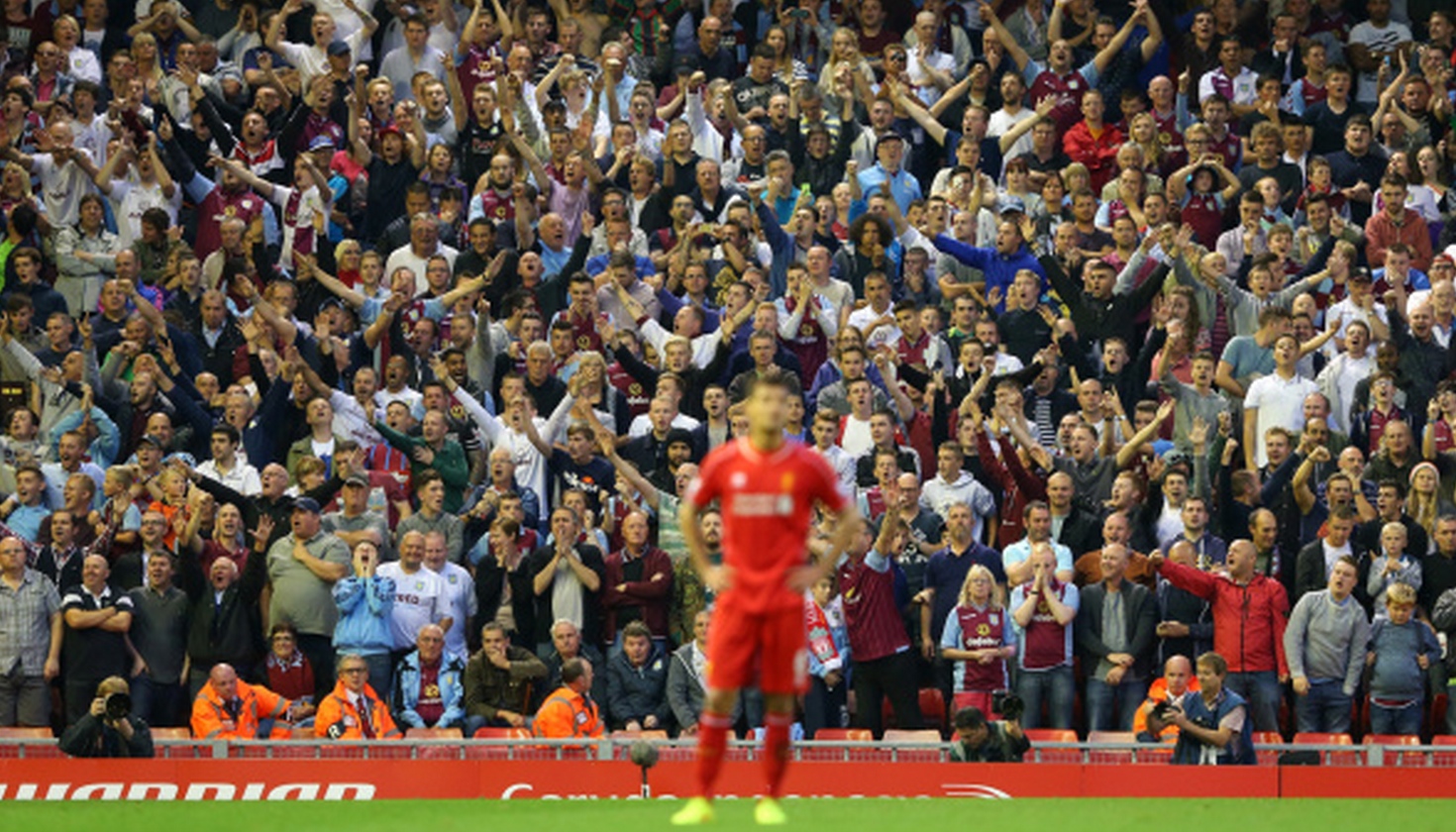

Saturday saw Aston Villa, Liverpool’s bogey side, come to Anfield. Positivity surrounded the pre-match build-up until rumours began to circulate on social media that Liverpool were to use a 4-2-3-1. And use it they did.
Adam Lallana came in for the injured Daniel Sturridge, and Lazar Markovic was brought in as Raheem Sterling was given valuable rest-time. This left Jordan Henderson in a double pivot with captain Gerrard, and Coutinho sitting in front of them in the #10 role.
Villa originally started with a 4-1-2-1-2, presumably to counter-act a potential Liverpool diamond, but reverted to a flat 4-5-1 after about five minutes, once they realised they were up against a 4-2-3-1.
At all times during their diamond, Villa had a man positioned within five yards of Steven Gerrard. Within both the original Villa diamond and their eventual flat 4-5-1, Gabriel Agbonlahor was given the role of man-marking Gerrard. When Liverpool had the ball, Agbonlahor was told to stick with Gerrard at all times and not worry about anything else.
Gerrard being man-marked had a huge impact on the game. Usually, Liverpool build up the vast majority of their possession through him. However, given he was marked at almost every opportunity, the pressures of fulfilling the first phase of build-up lay with Jordan Henderson. I imagine this is the very reason that Rodgers went with the 4-2-3-1; when Gerrard was inevitably man-marked, Henderson could drop between the central defenders and create the build-up himself.
But this double pivot didn’t work for several reasons. One of the main reasons was the detach between the deep midfield two and Philippe Coutinho, who was obviously told to play in a more advanced role than he’s comfortable with. With Villa’s flat midfield five, this often meant that Liverpool had to penetrate a wall of five, and as a result, the only time the Reds looked like worrying Villa was with a precise 20yard+ pass straight into the forwards.
Liverpool also missed the build-up influence of Daniel Sturridge and Raheem Sterling. Both are incredibly dynamic players and when Gerrard has the ball at the base of midfield, they will usually both be moving into different positions. Sturridge’s preferred move is to drift wide, usually to the right. Raheem Sterling will then drop in from the right hand-side to the centre of the pitch to act as another option for Gerrard, Coutinho or Henderson to play the ball in to in the initial phases of attack.

Above shows the shortage of options that Liverpool had in progressing the attacks. On the left is Liverpool’s usual build-up in a 4-3-3 versus the 4-2-3-1 build-up Liverpool had on Saturday.
It seems pretty clear to me which shape is more desirable in the early phases of an attack. It also shows how the 4-3-3 with Sturridge as the lone striker creates a faux-diamond with Sterling drifting infield. But that’s another article in itself.
Unfortunately Liverpool used the worse of these two shapes. This meant we had real trouble in building play through the centre of the pitch and it often led to aimless side-to-side possession with very little penetration. If a direct pass wasn’t on, the defenders and midfield would take the safest pass available, which was usually to the full-backs. Teams that sit as deep as Aston Villa did against us are more than happy to concede this area as it’s often very difficult to build-up attacks from those positions. Whilst Manquillo and Moreno are big improvements on last season’s full-backs, they don’t have the one on one ability of a prime Dani Alves, or the tactical intelligence of a Philipp Lahm.
Because of all this, the performance was reminiscent of a Liverpool performance during Rodgers’ first season, where the players were still becoming accustomed to his methods and philosophies. This is hardly a surprise given that the forward line were all new signings, and the midfield were all given completely new roles to deal with.
Mario Balotelli, for example, has already shown he’s keen to improve and work hard for Liverpool; but he doesn’t know the off-ball movement patterns that link up well with the midfield. His natural inclination is to stay in a fairly advanced central position with only the occasional foray out-wide if he’s not getting enough of the ball. If he’s to aid in Liverpool’s build-up in the same way as Daniel Sturridge, then he needs to be able to mirror the Englishmen’s off-ball movement when he’s up front on his own.
Sterling, Coutinho and their impact on build-up
There’s been a fair amount of discussion over the previous few weeks about what Coutinho’s best position is. During the first few weeks of the season, he was deployed on the left of a 4-3-3 and dropped when Liverpool reverted to a diamond against Spurs. Against Aston Villa he was played in the #10 role, a position I’d argue is still not his best.
And against a side like Villa, it’s almost certainly not his best. This is largely because when you’re wracking up numbers like 75% possession, your #10 is going to spend a large part of the game with his back to goal. That’s the way it works unless you’re particularly strong at keeping the ball in the final third. To play with your back to goal from the CAM position, you need two added attributes alongside the usual skill-set: game awareness and the ability to turn quickly & efficiently. Coutinho has wonderfully quick feet and therefore has the ability to turn a man, but his game awareness is fairly unpolished. This often means he has half a second less to weigh up his options before deciding on what he’s going to do with the ball; at the top level, this makes a massive difference. He then ends up rushing himself and is far more wasteful in possession. In contrast, when he carries the ball from the #8 position, he is far more comfortable; either creating an opportunity for a team-mate or taking on a man himself.
Raheem Sterling, on the other hand, is a bit special. Aged only 19, his game awareness and tactical intelligence are already very strong. Not only do his physical attributes mean he is able to glide away from a touch-tight defender, but he already knows where the ball is going when he receives it. This means he’s far less wasteful in the final third and is therefore a valuable asset in layering Liverpool’s build-up. It’s also no wonder he’s adapted to life at the tip of Liverpool’s (and more recently, England’s) diamond.
Sterling’s ability to act as a winger that drifts infield combined with Daniel Sturridge’s inclination to drift wide creates a fairly unique build-up pattern for Liverpool. As referenced earlier, it’s something of a faux-diamond in the early stages:

I’ve added in the passing options for the RCM (usually Jordan Henderson) in the 4-3-3; three slow build-up options, two medium, and two fast. Now compare this to his options in the Villa game; Gerrard was man-marked out of proceedings, Coutinho was too advanced to receive the ball, and Balotelli didn’t work the channels as effectively as Sturridge. This left Lazar Markovic as the only real direct option, with a switch in play having to be a long-ball, or recycled though the central defenders. That’s what happens when you surrender the centre of midfield by playing Coutinho too high, and it’s not a surprise Liverpool struggled to record any sort of real central penetration.
Beyond this phase of build-up, Liverpool’s play is far more fluid and is difficult to illustrate in such a way. The key point after this is that Henderson, Coutinho and Sterling will often rotate in a slow build-up (of which there were numerous against Villa). In a 4-2-3-1, this is difficult. There were times when Henderson and Coutinho interchanged against Villa, but it was far more scarce than the fluid midfield rotation that we’re used to. There were also times in the second half where Lazar Markovic began to drop deep in a Sterling-esque manner, but again, this was rare. Liverpool’s best moments seemed to come when Henderson did what Henderson usually does, and Markovic did what Raheem Sterling usually does. It’s therefore particularly surprising that Rodgers changed to a system that seemed to suppress their natural urges.
In the end all of this massively hindered Liverpool’s attacks, and Villa could have defended all day. It led to a single shot on target and a dismal attacking display. No more bloody 4-2-3-1 please, Brendan.



Comments.
Loading comments…