

I’ll take a wild guess here: The last time Liverpool won the league, you were not born. And if you were, you weren’t old enough to be able to remember it now. And if you can remember it, then, like me, you weren’t old enough to understand and appreciate its significance at the time.
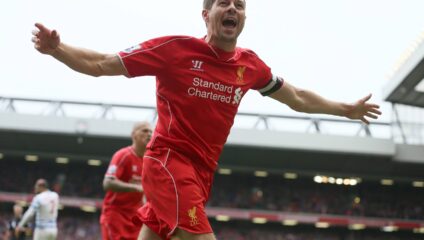
If none of that applies to you, you’re probably in a small minority among the people who will read this. It’s been the thick end of a quarter of a century since the Reds last reigned as champions of England, and a generation of us have grown up never having known the feeling of being the best in the land. Some truly great players and managers have been and gone since 1990, and one remains, yet we’ve never seen Steven Gerrard or any of the rest of them the hold the Premier League trophy aloft. We’ve never known the euphoria of those immediately after the referee’s full-time whistle has confirmed, finally, after nine months of agony, ecstasy, and sub-zero mid-week away fixtures in December, that the most coveted piece of silverware in the country will shortly be paraded around Anfield. And we’ve never watched, read or listened to season previews which refer to Liverpool with the prefix of “champions” when it all starts again in August.
The general consensus is that responsibility for the 23-year league title drought is shared between former managers, owners, and a certain Knight of the Realm who ultimately bestowed upon Manchester United a successor best known for his dedication of the art of demonstrating that you don’t need trophies to be a winner (but he is a winner). Most Reds would tell you that the rot began with the drastic, divisive changes and the raft of poor signings made by Graeme Souness in the early ‘90s, while in the boardroom, David Moores and Rick Parry would go on to preside over years of complacency and commercial torpor, before ultimately selling the family silver to two chancers in George Gillett and Tom Hicks whose dubious credentials could have been revealed with recourse to Google had Moores and Parry not still been living in the era of the Filofax. And of course, there might be a grudging nod to the aforementioned Knight of the Realm for being exceptionally good at managing Manchester United, and a reproachful glare toward a few Sheikhs and oligarchs for being exceptionally wealthy, and for radically altering the footballing landscape with their petrobillions.
Oh, and one towards Andre Marriner.
Andre Marriner?
Yep. That’s my opinion anyway, and I’m sticking to it. You see, football, low-scoring game that it is, is an endeavour in which the small details are often decisive. Just ask Rafa Benítez, the man who got us closer to that elusive league title than anyone else has since 1990. Besides “quality” and “mentality”, there is nothing Rafa stressed the importance of more often than those small details. Many of those details are at least partially within the control of a club and its manager, but over the course of a season, you’ll frequently gain or drop points on the basis of nothing more earned or merited than falling either side of certain ultra-fine margins. Or, to put it another way, luck. A divot in the best (or worst) possible place. A questionable offside call.
An incorrectly disallowed goal.
Benítez’s 2008/09 Liverpool side finished the Premier League season with 86 points, four points behind winners United, having scored nine more goals than the champions, and with a goal difference superior by six. They were beaten only twice over 38 fixtures, making them the only top flight team in English football history to fail to win the league having lost just two matches. Since the introduction of three points for a win in 1981, only United in 2011/12 have bettered the 2.263 points-per-game average posted by Liverpool in 2008/09 without being crowned champions, and they were only beaten (quite hilariously) on goal difference with the last meaningful kick of the season, having matched Manchester City’s total of 89 points.
Four points. Two disappointing home draws. A couple of off days. Remarkably, despite collecting 86 points, Liverpool had seven such off days at Anfield in 2008/09. The first came against newly-promoted Stoke City in the Reds’ fifth league fixture on the 20th of September 2008. But it could, and should, have been so different.
A left-sided Gerrard free kick had appeared to give Liverpool the lead after just 76 seconds, having found its way into the net without any other player getting a touch. Yet referee Marriner inexplicably disallowed the goal, seemingly in the mistaken belief that either Fernando Torres or Dirk Kuyt had directed the ball in from an offside position.
That left Liverpool with another 89 minutes to break the deadlock, yet despite enjoying 76% of possession, winning 19 corners, registering 30 shots at goal, and restricting the visitors to a single, off-target attempt, Benítez’s men somehow failed to score.
It’d be unfair to blame that one wrong call in the second minute for the draw though, wouldn’t it? I’m not so sure. Consider, for instance, that when Thomas Sørensen was beaten by a third-minute Cristiano Ronaldo free kick at Old Trafford two months later, Stoke went on to lose 5-0. It’s unlikely that Tony Pulis’s side would have responded a great deal better in the wake of a similar blow to their gameplan and resolve at Anfield, particularly against a Liverpool side full of confidence following hard-fought wins over United and Marseille.
But it was only two points dropped, and we missed out by four, right? Two of the remaining six home draws that season were excusable enough, coming as they did against Everton and Arsenal, but just a single win in any of the other four, against Fulham, West Ham United, Hull City, and a then thoroughly mediocre Manchester City, would not only have been worth a vital two points for the Reds, but may also have presented a greater test of United’s ability to keep winning with the increased pressure it would have placed upon Sir Alex Ferguson’s side. And while it may only have been two points on that particular day against Stoke, you have to wonder what effect that freak result had upon the team’s mentality, and thus, performance, when the openings weren’t appearing and the Anfield crowd started to grow restless in subsequent stalemates against sides they really ought to have been beating.
All those millions wasted on high-profile flops, all those years falling further behind our rivals on the commercial and operational fronts under complacent leadership, all the in-fighting at board level, all those debts which ultimately threatened to drown the club, none of it, not even George Gillett and Tom Hicks, was enough to deny a generation of Liverpool fans the unequalled joy of being champions of England. For that you can arguably thank a referee from Birmingham and good old-fashioned bad luck. Small details, eh?
Let’s just hope Brendan stays well clear of any ladders he sees between now and the New Year…


Comments.
Loading comments…