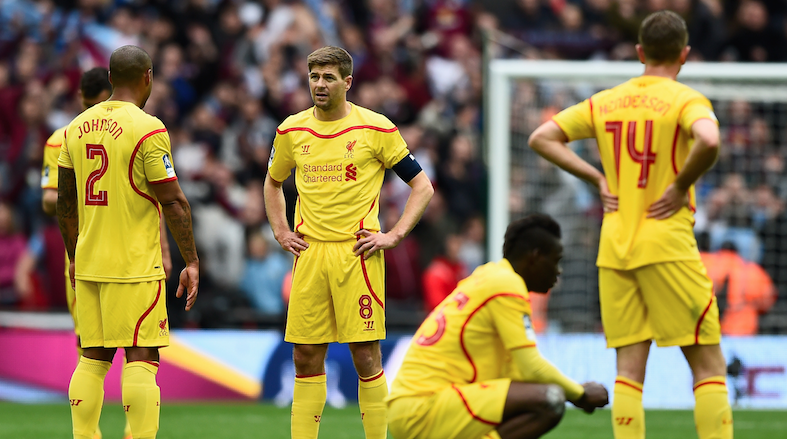

In their final Premier League match, Liverpool lost 6-1 away to Stoke City. Most telling was the parenthetical (six) that appeared in so many media outlet box scores, as if to rub in the reality of it. Yes, that is the number six. Stoke scored 6 (six) on Liverpool. Losing to Stoke, but more the way loss unfolded, has to be the nadir of the Reds’ horrible, horrible campaign.
It is almost fitting that it was the final match, a funhouse encapsulation of all that went wrong in this season after coming so tantalisingly close to winning the league in the last.
So another season passes on Merseyside, full of disappointments and perhaps a taste even more bitter than recent memory.
The club now finds itself even more precariously situated on a dangerous precipice between football’s giant clubs and the widening abyss that engulfs of every other club. Questions abound and changes are required. This offseason may prove more pivotal than any in recent memory, tipping the club one way or other from the edge.
Here are four findings from this season:
1) Strange symmetry
Beginnings and endings are important. If they are strong enough, the middle doesn’t matter as much. The same could be said of a football season.
Liverpool neither started nor finished well.
With a sputtering start and search for answers the pressure increased early. From August to December, the Reds chased crisis with a bizarre desperation, bouncing back and forth between the top four and mid-table mediocrity. Only twice did they have more wins than losses prior to Boxing Day, match day 18.

Then the finish saw just two victories from the last nine matches, including five losses, totalling just eight points. Once Liverpool capitulated against Manchester United, again, the descent accelerated with the only reprieve, wins against Newcastle United, unsafe until the final day, and relegated Queens Park Rangers.
Either end of the season were poor making it harder to remember the strong run in the middle.
Similarly, teams can also be poor at either end, leaving the middle more forgettable.
Liverpool’s squad lacks quality in both boxes. It took major adjustments by Brendan Rodgers to stave the shipping of goals and his complete lack of faith in the strikers at his disposal meant it was difficult to see where the goals were in the side.
In defence, it started with the goalkeeper. While his remarkable recovery is notable, Simon Mignolet began the season short on confidence and shellshocked.
The arrival of Rodgers’ favourite Dejan Lovren has been disastrous. His erratic play unsettled the entire defensive unit, if not the team.
Equally problematic were the full-back positions, where no player was able to nail their name to the top of the team sheet. These questions did little to bolster the other players, who may not have been terrible but neither stood out as consistently superior.
In attack, fitness and form conspired to create long lasting problems that players nor manager seemed capable of sorting. No one could have predicted that Daniel Sturridge would be shelved for so long and require surgery, but he has not been the most reliable striker either. That does not explain why the combination of Rickie Lambert, Mario Balotelli, Fabio Borini, and Lazar Markovic were used poorly and only contributed six league goals.

Combine the failings in both boxes and strength in the middle fades. Liverpool are flush with midfield players of varying ability and overall quality. However, forcing many them to play out of their natural position or conform to tactical limitations that diminish their effectiveness became commonplace.
The overall squad is stronger than it was three years ago when Rodgers arrived but the results are not altogether different. The end of this three season cycle has ended poorly and not entirely unlike how it began, with the exception of more optimism at the end of year one.
2) Multiple misses
If this season had a slogan it would undoubtedly be ‘opportunities missed’.
At every turn, Liverpool missed chances to salvage their campaigns on multiple fronts. They continually made their challenges harder, compounding the effort required and minimising their chance of success. The toll it took became more obvious in the final weeks.
The misses started early with the offseason Suárez/Sanchez saga being the harbinger of ominous signs. Whether Liverpool knew Luis Suárez was going to make his getaway or not is unknown. However, given the previous summer, the club could have been in no doubt it was always a question of when not if. Anyone thinking that an event like the World Cup would not be used as a staging ground for departure is naive.
Granted Suárez was recovering from knee surgery and he certainly did not cover himself in glory sinking his teeth into Giorgio Chiellini, but he had the season of his life and his star had never been higher. For Liverpool not to get Sanchez as a requirement for that transfer made all the strength and grandstanding with Arsenal look empty.
Yet again, the club was entering a season short on strikers with seeming no contingency plan. Once Sturridge when down, things accelerated from bad to worse.

In the league, Liverpool spent the first half of the season in search of an identity and goals, missing chances on the pitch and in the table to take advantage of a soft schedule. In the first 15 matches, Liverpool lost or gave points to four sides that spent the majority of the season in danger of relegation: Aston Villa, Newcastle, Sunderland, and Hull City. The best of any of those teams finished was 15th. In the season, Crystal Palace did the double over them and they only managed a point against relegated Hull.
In the FA Cup, the Reds had to replay two Championship sides to advance in rounds four and six, forcing extra matches they certainly could have done without. Then they logged one of their worst performances against Aston Villa in the semi-final, ruining the Steven Gerrard birthday sendoff in the process.
Even their Capital One Cup run was blighted by the endless penalty kick shootout that was required to beat another Championship club, Middlesborough.
In their return to the Champions League, they managed to win just won game and only just benefitting from a penalty called in stoppage time. When they needed to beat Basel, at home, to advance to the knockout stage they fell behind and were barely able to get a draw.
January came and went and no discernible attempt was made to reinforce the squad sadly lacking in goals.
Of course things did look like they might be rectified as the festive season seemed to spark a memory of performances that had been lacking, but when faced with the opportunity to overleap hated rivals Manchester United and return to the top four, Liverpool faltered, followed by an even uglier effort at Arsenal.
Multiple chances were there for Liverpool’s to wrestle themselves back into the table’s money places, as late as April and the Reds found a way to miss them all, often looking even worse the larger the occasion or opportunity.
Winning is a habit just as much as losing is, but it is a habit this squad still seeks.
3) A hangman’s history
Liverpool’s legacy boasts extremes of glorious triumphs and horrible tribulations. The club and its supporters have experienced the highest and lowest that life connected to football has to offer. The weight of that history comes into sharper focus now and again.
Short term, the current squad looked almost unrecognisable to the one that nearly wrote its own new history. Long term, the view of the club is far more complicated.
For one, the media is a-flood with names from Liverpool’s glorious past. In print, radio, and television nearly every outlet includes an ex-Liverpool player reminding everyone of the club’s history and importance, and inadvertently or not measuring this side or these players against the long stick of nostalgia.
It may be unfair. It may be unrealistic. But it simply is.
After five years of missing out on the Champions League, supporters rejoiced with the Reds’ return to Europe. Plus, the club could not have got a better draw to advance beyond the group stages. They didn’t. Supporters were reliving and looking forward to those European nights with relish. Liverpool were back.
Except the manager’s naivety on the continent was exposed. In autumn, the side searched through a malaise, having to reconcile the previous year’s missed title and replacing their best player, rarely looking up for league matches let alone a midweek tournament.

Walking into the club, past those five cups and all the other silverware, undoubtedly is daunting. The ghosts of Anfield loom large and load expectations. Rodgers has been fond of talking of heavy shirts but his suit has certainly grown heavier too. Greater men than Rodgers have been broken by the weight of the club.
Still, the 10-year reunion of the miracle of Istanbul had to have been particularly suffocating this year. Timing can be particularly cruel. Returning to the Champions League only to sputter and skulk, while feature films and events about the club’s last great victory could only make the weight a bit heavier.
As the current squad limped to this season’s end, anniversary affairs reached a peak. The contrast only serves to intensify the longing of the supporters for something better from their football club.
Nonetheless, pressure is a privilege and Liverpool Football Club is a victim of its own storied success. Considering that the title of England’s most successful club has only been lost during the most recent spell in the European wilderness makes the sting still very real. The longer the trophy and title drought the greater the burden. Season’s like this one bring this truth into even starker relief.
4) Faults and failings
Something is fundamentally broken inside Liverpool Football Club, at the minute.
Significant and deep faultlines exist.
Flaws were exposed all over the shop this year at nearly every level. Consequently the only conclusion, all of the individuals making decisions about the club have either simply not done enough or not done enough of the right things to shore up the structure and ready Liverpool FC to rejoin the its proper place amongst the world’s elite. It is no small task, to be sure, but it remains ever-present.
For all the stick that Fenway Sports Group has been getting, they saved the club from free fall and have gone about stabilising the institution. As much as supporters hate to hear about the long view, FSG does seem to be taking a long view approach.
However, what the long view often misses is just how much and how quickly the football world changes. All things are not equal, the system continually rewards top clubs the most, while looking for every possible way to insure those top places and prizes remain secure among the big club cartel.
Moreover, Financial Fair Play is a fantasy that is losing its soft focus altogether, revealing just how cruel and ruthless global football truly is at present.
Still, Liverpool have spent the last 25 years, through various ownerships, finding new and different ways to prove just how true the new footballing reality is and how poorly the club has been stewarded through it. FSG may provide a steady hand, but they also need to show a firm, decisive, and implacable one.

The honeymoon is definitively over and major changes need to be made, whatever the “model” is. For a club that increasingly finds itself on the outside looking in at the big club cartel, clear lines must be drawn about what is expected, acceptable, and the inevitable consequences of failure, not the least of which is losing 6-1 to Stoke.
Last year there was optimism and it looked like Liverpool were beginning to close the gap. Commercial interests have grown and the stadium issue has finally been resolved, to a debatable degree, but things look eerily similar to what they did three years ago. The on-field product improved only to regress. The manager grew only to regress. Even the club has grown, to a degree, only to regress.
To pretend otherwise is pure folly.
Missing the Champions League in a down year, the club missed an achievable get worth well over £50 million. The lost revenue is near another Suárez replacement fund, handy for a club missing a top striker. Worse still, the club is likely to lose this season’s best player again, in addition to one of the all-time greats. The hole looks like it is widening.
Whether a director of football needs appointing or a new manager needs finding is subject to debate. What is not subject to debate is the need for top quality talent, especially around the goal at either end of the pitch.
Clear solutions need devising, another sizeable investment must be made, but fundamental aspects need mending and quickly. The other big clubs are retooling, growing stronger, and leaving an even wider wake.
The chase will only prove more difficult until Liverpool catches and can stay competitive with them. The alternative is that they fall so far off the pace to extend their one trophy in nine years run to more permanent status.


Comments.
Loading comments…